
Most flooring decisions get made in a showroom, in air conditioning, with a sample resting flat on a counter.
The floor then goes down on a ground-floor slab. That slab has sat in damp soil since the concrete went in, under a roof that turns the room into a greenhouse by mid-afternoon. That gap between the sample and the site is where most tropical flooring regret comes from.
Every SPC vs LVT flooring comparison starts with the same two claims. Both are waterproof, and both click into place over an existing floor with no glue and no demolition.
So the real question isn’t which one survives water, and it isn’t which one is easier to install. It’s what’s underneath the surface layer, because that’s where the two products actually part ways.
Built for a climate that doesn’t let up
Humidity in the tropics never really lets up, and that’s the real test for SPC flooring and LVT alike. BMKG’s four Bali stations recorded 2022 annual averages of roughly 80 to 85 per cent, and no monthly average at any of them dropped below 77. There’s no dry season in which a floor gets a real break, exactly the case for waterproof flooring tropical buyers actually need to plan around.
Click-lock flooring handles that reasonably well by design: the planks aren’t bonded to the slab, so they aren’t stressed by whatever the slab is doing underneath. That’s true of both SPC and LVT. Where the two diverge is how each behaves once installed, especially under heavy sun or heavy foot traffic.
Where the rigid core earns its keep
SPC flooring gets its name from its engineered stone core, a stone-polymer composite that resists expansion and contraction far better than standard flexible vinyl. United Floor Indonesia makes the same case for the local market, recommending rigid-core SPC over ordinary vinyl specifically because Indonesian conditions punish anything that moves.
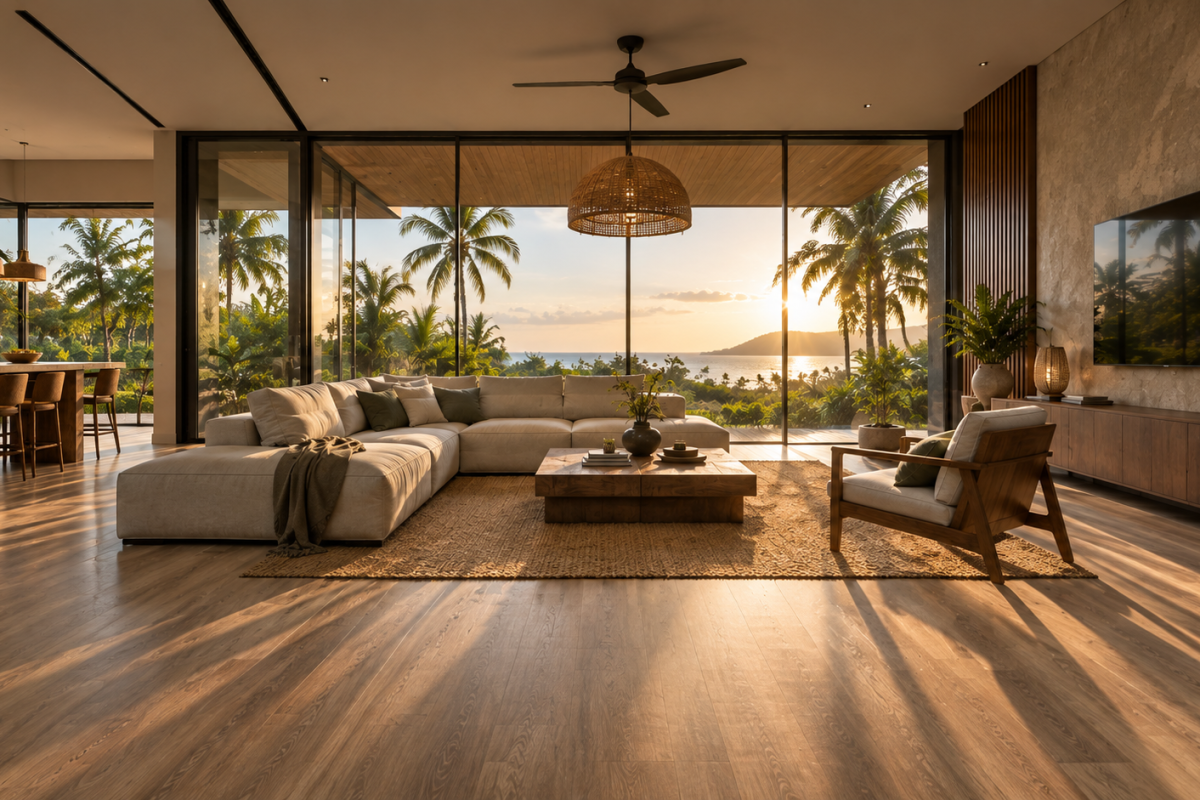
That stability matters most in rooms that punish it hardest. Think of a living area with full-height western glazing, where hours of afternoon sun heat the floor and everything around it. A rigid core holds its dimensions through that cycle far more predictably than a flexible one.
It’s not free stability, though. A floating system still needs correctly sized expansion gaps at every wall, door frame, and column. The floor moves as one continuous field, even when the core itself resists moving.
Skip that detail and even the most dimensionally stable core will eventually meet its limit at the perimeter. Ask any supplier how they detail expansion gaps before you ask about price.
Where the flexible core earns its keep
LVT trades some of that rigidity for comfort. Home Style’s own description is direct about this: LVT feels quieter and warmer underfoot than the stone-polymer alternative, with the same waterproof core technology.
That difference shows up most in upstairs rooms. A rigid floor sitting over an air gap tends to carry footfall as a hollow tap into the room below.
Home Style’s LVT line ships with a Sound Choice acoustic backing bonded to a 4.5 mm plank with a 0.55 mm wear layer. Its flexible core absorbs impact rather than transmitting it the way a rigid core does. For a bedroom above a living room, that’s often worth more than the rigidity gains elsewhere in the home.
Renovating over what’s already there
Most renovations that switch to SPC flooring or LVT begin on top of existing ceramic or terrazzo, because that’s what the previous owner laid. In an older Bali house or villa that’s often terrazzo. In a Jakarta apartment it’s more likely ceramic over a suspended slab.
Either SPC or LVT gives you flooring over existing tile without demolition, rubble disposal, or a week of dust through the rest of the home. That’s true of both lines, not a reason to choose one over the other. What decides it is the room itself: a sun-heavy living area favours the rigid core, an upstairs bedroom favours the quieter one.
Where neither one belongs
Neither SPC flooring nor LVT is an outdoor product. Unshaded terraces, pool surrounds, and open-air decks expose vinyl flooring to UV and surface temperatures it wasn’t built for, whatever the fade rating says. For those zones, wood-composite decking or natural stone is the correct specification, and the vinyl conversation should stop at the covered threshold.
Knowing this before you buy is more useful than filing a warranty claim afterwards.
How we specify it
Home Style supplies both SPC flooring and LVT lines under Induro, our flooring brand engineered for Indonesia’s tropical climate. Both click into place with no glue and no nails, and a 100 m² room typically installs in a single day.
The LVT line runs 4.5 mm total with a 0.55 mm wear layer measured to EN ISO 24340. It carries a Ceramor UV-stabilised ceramic bead coating and Sound Choice acoustic backing, in 25 x 100 cm planks. Both lines carry anti-termite flooring ratings, anti-slip, scratch-resistant, fade- and fire-resistant, and zero-formaldehyde protection, plus the LVT includes 39 per cent pre-consumer recycled content.
The best flooring for villa projects usually isn’t one line or the other. In practice we lean toward SPC flooring for large, sun-exposed ground-floor rooms and toward LVT for upstairs bedrooms and anywhere quiet underfoot matters more than maximum rigidity. Most projects end up using both, room by room.
Samples behave differently in your own light and against your own cabinetry. Contact us for free consultation, or bring your plans to the showroom in Seminyak or Alam Sutera and we will start with the slab.
