A turnkey fit-out partner proves its worth at the handovers, the points where one trade’s finished work becomes the next trade’s starting line. That’s where a villa or hotel fit-out slips: a floor changes a door height, a countertop waits for a template, and the supplier can’t order glass until the tiles are down.
What a turnkey fit-out partner means in practice
Turnkey means one contract, one programme, and one party answerable from design through installation. In practice the word covers very different arrangements. Some partners manufacture most of the scope. Others coordinate subcontractors under a single invoice. Both can work, but they carry different risk: every subcontractor adds one more handover that you depend on someone else to manage.
Five handovers where schedules slip
Floor build-up and door height. Finished floor thickness sets the door undercut and the thresholds. A 4.5 mm vinyl floor sits low. A tiled floor adds the tile plus an adhesive layer of around 3 mm, which can reach 10 mm depending on tile size and substrate flatness. When a supplier cuts doors before anyone confirms the floor finish, crews may have to trim them on site.
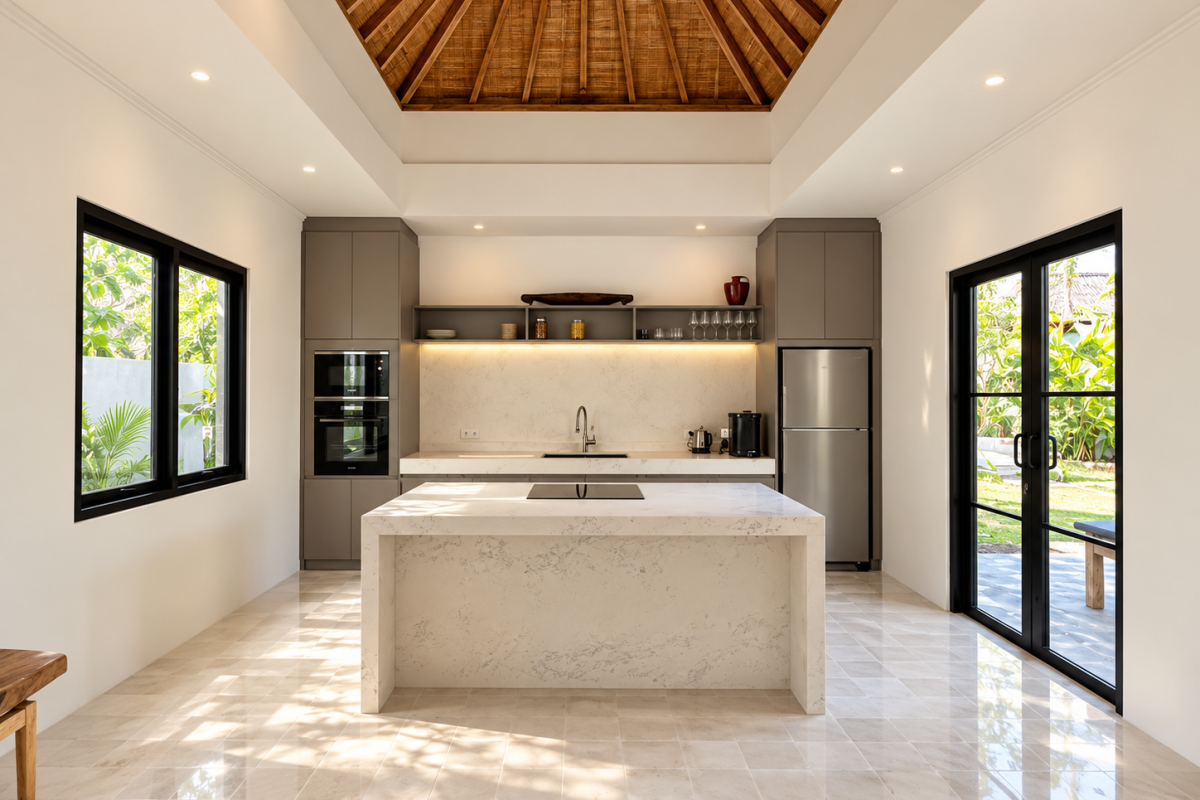
Countertop templating. A fabricator measures a quartz countertop only after the installer has fully fixed, levelled, and fastened the base cabinets, then cuts and finishes it. The cabinet installation date therefore sets the countertop date. Confirm sink and hob models before templating, because the cut-outs depend on them.
Services and the cabinet grid. Modular cabinets come in fixed widths and depths, so the team can set water and power points from drawings before anything arrives. Ask whether the partner coordinates services on shop drawings or discovers them on site.
Glass and wet areas. Nobody can cut, drill, or reshape tempered glass after tempering, so the supplier orders shower screens against measurements taken once tiling is complete. Waterproofing goes on before tile and needs a day or two to cure. Both belong on the programme as their own lines. A partner who schedules the measure early absorbs the glass lead time instead of leaving a finished bathroom waiting.
Colour and batch consistency. Quartz can vary slightly from one production lot to another, and manufacturers advise drawing every slab for a job from the same lot. On a multi-villa or multi-room scheme, order each phase’s quantity together and keep a spare allowance, so a later replacement doesn’t have to match a different lot.
Questions to ask a turnkey fit-out partner before you shortlist
- Who makes what? Ask for a scope list that marks what they make in their own factory, buy in, or subcontract.
- Can we see a programme? Request a sample from a past project that covers all trades.
- Where are the hold points? Both sides should sign off shop drawings before anyone cuts material, with a named signatory on each side.
- Are the licences current? Construction service businesses in Indonesia must hold an SBU, the Sertifikat Badan Usaha.
- Is the SBU valid? Check its status, classification, and validity on SIKI using the company’s NIB. Confirm the classification covers interior work and note the expiry date.
- Where does the timber come from? For timber-based components, ask how the supplier documents the legal origin of its wood, including SVLK where it applies.
- What suits the climate? In Bali and coastal Java, ask which components the supplier specifies for humidity, termites, and UV, and what evidence backs that.
- Who answers after handover? Clarify the warranty owner, spare-part supply, and lot matching for replacements.
- Can we visit a finished project at least a year old? Joints, sealant lines, and door alignment show how well the team built it once a wet season has passed.
Tie payment to handovers, not just dates
Link milestone payments to signed-off interfaces: a stage payment on approved shop drawings, another on completed services rough-in, and a retention held until snagging closes. That keeps the partner’s cash flow tied to closed handovers.
Ask how a prospective villa fit-out contractor or hospitality interior contractor prices changes after drawing sign-off. Ask also whether the quote shows the cost of a late client decision or leaves it to surface later. Quotes that separate design, manufacture, and installation make partners easy to compare. A single lump sum hides where the margin sits.
Villas and hospitality weigh these differently
Some villa owners manage a build from overseas, so reporting decides the choice: one point of contact, dated progress photographs, and a snagging process that works without anyone on site.
Hospitality projects usually carry a fixed opening date, so teams weigh phased handover by floor or zone, repeatable specifications across keys, and a snagging window before the first guest. A partner strong in one type isn’t automatically strong in the other, so ask for a reference that matches yours.
Where Home Style fits
We design, manufacture, and install across nine product categories, with 40 years of experience and more than 500 completed projects, so many of the handovers above sit inside one team.
If you’re scoping a villa or hospitality project, a Home Style design consultant can review your drawings for these handovers before you tender.