Cooking in Indonesia means turmeric, sambal, lime, hot oil, and a wok that goes straight from the flame to the counter, all in humidity that never drops. Here’s a kitchen countertop comparison of a quartz countertop, a granite countertop, and a marble countertop on the three tests that matter most in our kitchens: heat, acid, and stains.
Kitchen countertop comparison: granite, marble, and quartz
| Granite | Marble | Quartz | |
|---|---|---|---|
| Heat | Tolerant | Tolerant | Needs a trivet |
| Acid (lime, vinegar) | More resistant, avoid strong acids | Etches | Resistant |
| Pores and stains | Porous, needs sealer | Porous, needs regular sealing | Non-porous |
| Upkeep | Periodic sealer | Sealer about every six months | Soap and water |
Granite: strong against heat, but it depends on its sealer
Granite consists of feldspar, quartz, and mica, which makes it hard and heat tolerant. A pot straight off the stove is generally fine on it, though a very heavy wok or a sudden temperature swing still deserves care.
Its weakness is porosity. Unsealed granite absorbs liquid, so wipe spilled soy sauce, turmeric, or oil quickly. Avoid cleaning it with vinegar or lemon. Edges and corners can also chip, and repairs call for a professional.
In a humid kitchen, the sealer decides how well granite performs. Once it wears thin, the pores reopen, and that’s where stains settle.
Marble: the finest veining, the most upkeep
Marble consists of calcite, or calcium carbonate. It reacts with acid, so lime juice, vinegar, or lemon leaves a stain and also eats into the surface, leaving a dull patch known as etching. A kitchen that cooks often with lime and tomato sambal will see this sooner than one that cooks rarely.
Marble is also softer, scratches under a knife, and is porous enough for coffee or oil to soak in. Plan to reseal about every six months. Marble suits areas that seldom meet cooking ingredients, such as a bar counter or the side of an island that isn’t used for chopping.
Quartz: strongest on pores and acid, with one catch
Quartz is an engineered stone. Indoquartz, for example, is over 90% natural quartz, with the remainder made up of other minerals, binders, and pigment. Because it is nearly non-porous, liquid struggles to soak in, and the surface needs no sealing. Soap and water are enough.
The catch is the binder. Quartz doesn’t tolerate heat as well as granite, so a pan fresh off the flame shouldn’t go straight onto it. Keep a trivet close; heat is where quartz needs the most care.
Granite and marble patterns don’t have to mean the real stone
Many people choose marble for its veining, not for how the stone behaves. You can separate the look from the material.
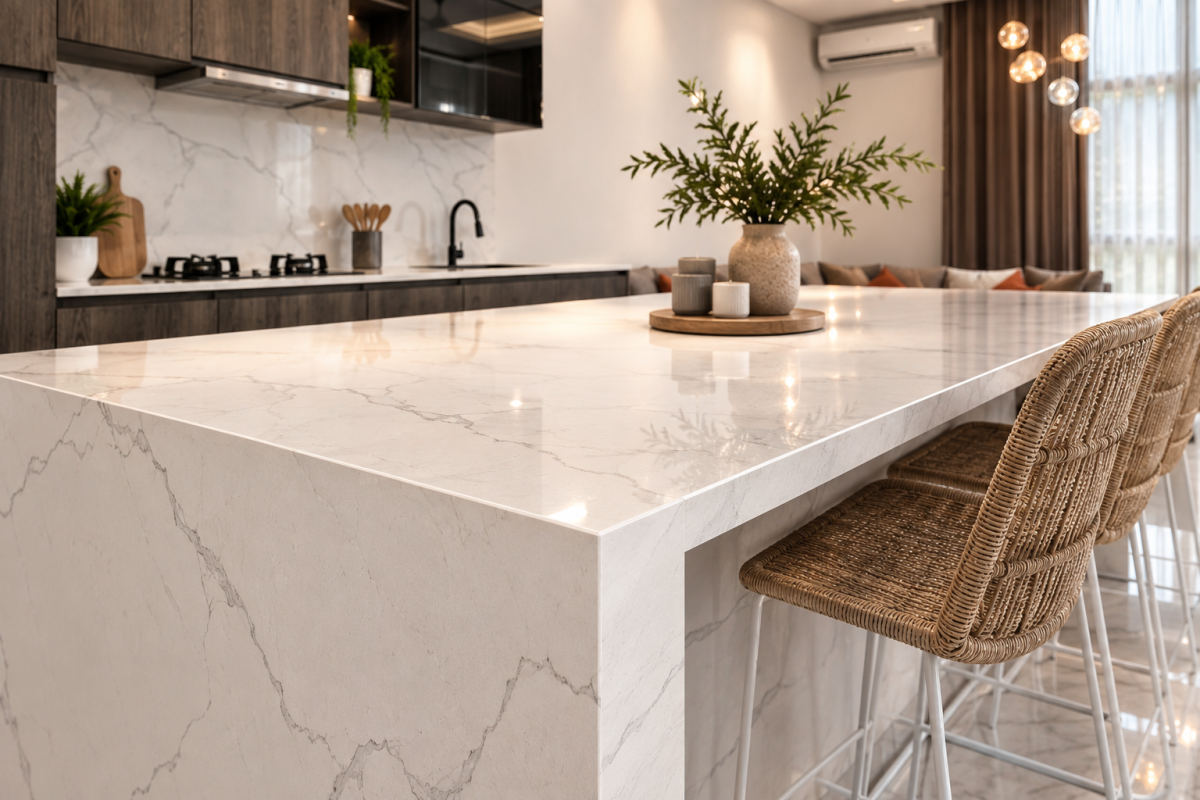
Our quartz comes in three pattern series: Terrazzo, Granite, and Marble. The Marble series includes Carrara White and Calacatta, while the Granite series includes Metropolis Grey and Black Alta. All of them are quartz, so you get the pattern of natural stone on a non-porous surface.
For a kitchen that runs several metres, there’s another advantage. Natural slabs each carry different veining, whereas quartz gives a more consistent pattern along the whole counter.
Humidity, seams, and wet zones
In a humid climate like Bali and Jakarta, water and oil tend to linger in two places: the pores of the stone and the gaps at the seams. A non-porous surface reduces the first. For the second, ask your installer how many seams your layout needs and where they fall, especially around the sink and the hob. A well-planned seam is nearly invisible.
Choosing the best countertop material for how you cook
- Choose granite if you cook over high heat, regularly set hot pans on the counter, and don’t mind resealing periodically.
- Choose marble if appearance comes first and you’re prepared to maintain it, or use it only where acidic ingredients rarely reach.
- Choose quartz if you want simple upkeep, a non-porous surface, and a consistent pattern, along with the habit of using a trivet.
A combination also works. Many kitchens use quartz in the cooking and sink zones and keep natural stone for the bar counter.
From selection to installation
We manufacture Indoquartz ourselves, and quartz is the standard countertop in Astera Kitchen, our modular kitchen concept. With four decades of experience, our design team helps you match the material to the way you cook.
If you’re planning a kitchen, a design consultant at our Seminyak or Alam Sutera showroom can show you pattern samples and talk through the seam layout with you. You can also browse our countertop collection whenever you’re ready.